A COHERENT FRAMEWORK for DANIEL and REVELATION
AI assistance was instrumental in creating this site and would not have been possible to align the similar structures of Daniel and Revelation without it.
DANIELS STATUE TO REVELATIONS SEALS
Comparing Daniel's statue with Revelation's seals.
We start off in Daniel chapter two, verse thirty seven. Daniel told Nebuchadnezzar that he was the King of Kings with power, strength, and glory. In verse thirty eight he says thou art this head of gold. In verse thirty nine he tells him that another kingdom will arise that is inferior to him. In verse forty five we learn the second kingdom was silver. Back to verse thirty nine he says the third kingdom would be brass, the fourth kingdom (in verse forty) is strong as iron. The fifth kingdom (the feet) is made up of iron and clay, and the final power structure being ten toes with the same mixture of iron and clay. It says in verse forty five that the stone, that was cut out of the mountain without hands, will break in pieces the iron, brass, clay, silver, and gold. The image is destroyed at the end for a kingdom, which will never be destroyed.
We are now going to compare Revelation represents five powers. This representation is structured differently and does not address the ten toes, but continues on into the seven last plagues.
Starting in Revelation 6, verse two, the first seal is opened and there appears a white horse. The white horse would align with the head of gold, being the finest horse with the others inferior to it, just as gold was the most precious metal. According to Daniel, this would be the kingdom of Babylon.
In verse four the second seal is opened and the second horse is red. This is comparable to the breast and arms of silver in Daniel's statue.
In verse five the third seal, the horse is black, and the rider carries a pair of balances. This symbolizes a kingdom where commerce is its legacy portrayed by wheat, barley, oil and wine. This power would be comparable to the belly and thighs of brass in Daniel's statue.
In verse eight the fourth seal is opened, and it is a pale horse. He's notorious for death and hell and kills with the sword and hunger, death, and the beast's of the Earth. This would be comparable to the iron legs of Daniel's statue. Just as the legs of the statue are the longest part of this illustration in Daniel, Revelation depicts a long period of time to the next kingdom as well.
When the fifth seal is opened (Revelation 6, verse nine) there is a long span portrayed until the next kingdom, because the souls that had died for the word of God ask, how long until their blood is avenged. They were given white robes and told that they would have to wait for their brethren, who were to die as they had, was fulfilled.
In verse 12, when the sixth seal is opened, there was a tremendous exhibition of an unprecedented, and mighty power. This was such an overwhelming display of power that everyone hid in the dens and rocks of the mountains. With this wrath, no one would be able to stand and signifies the appearance of another world power. The power represented here is the same power represented in Daniel with the feet of iron and clay, although Revelation does not address the ten toes yet. It will be later in the seven headed beast with ten horns.
In Revelation chapter 7 verse one, after this display of power, there are four angels, holding back this horrific event from happening again until the appointed time. This unprecedented display of power will happen once again in the seventh seal, in Revelation 9, verse fourteen.
Continuing on with the opening of the seventh seal, in Revelation eight, verse one. At this point, the seven vials (or bowls) are going to be mentioned at the same time because of their similarities. These are two descriptions of the same event. They are reiterated again for the second time in Revelation because of their significance. (Found in Revelation chapter fifteen and sixteen).
In Revelation eight, verse seven, the first Angel sounded his trumpet and a hail of fire mingled with blood is cast to the Earth, and a third part of the trees were burnt up and all the green grass. In the Vials mankind gets a noisome and grievous sore.
In verse eight, the second angel sounded, and there was a great mountain burning with fire cast into the sea, and a third part of the sea became blood. In the vials, this second angel poured out his vial upon the sea, and it became as blood of a dead man, and every living soul died in the sea. A third of the creatures in the sea died and a third part of the ships were destroyed.
When the third angel sounds (in verse ten) a great star fell from heaven, burning like a lamp, upon a third part of the waters and the fountains of waters. The star is called wormwood and the water became as wormwood, and many men died because the waters were bitter. When the third angel poured out his vial, the rivers and fountains of waters became blood.
In verse twelve the fourth angel sounded and the sun, moon and the stars were smitten. They were darkened by a third, so that they were not as bright as before. In the vials, the fourth angel poured out his upon the sun, the sun was given power to scorch men with fire, mankind was scorched with a great heat.
This is a good point to stop and consider the wording and sentence structure along with the content. Notice the trumpets tend to look at the effects on the Earth, and the vials tend to dwell on the effects to mankind.
Another important factor is the narrative after the fourth trumpet and vial. There is no narrative on the first three trumpets, but after the fourth trumpet, there is an angel flying through the midst of heaven, saying with a loud voice woe, woe, woe, unto the inhabitants of the Earth because there are three trumpets yet to sound. Likewise, in the vials, there is no narrative after the first three, but after the fourth vial mankind blasphemed God who had power over these plagues. This is a strong indication that the first four trumpets and vials are one event.
In Daniel, the last thing mentioned is a stone carved out of a mountain without hands that strikes the image, destroying it. That aligns with these first four events, especially the description of a mountain crashing into the ocean. This would set in motion events that would align with the stone filling the whole Earth that represented God's final kingdom.
In chapter nine, verse one, the fifth angel sounded, and there was a star that fell onto earth, given the key to the bottomless pit. Out of the pit arose smoke as of a great furnace, and the sun and air were darkened. Out of the smoke locusts came upon the Earth and they hurt men for five months. This event did not hurt the Earth, nothing green, none of the trees, but only men. The locust appeared as if they were ready for battle. They had a head that looked like a man with a crown of gold and the hair of women and teeth of lions. As well as having heads, they had tails like a scorpion, and the sting was in their tails. The power was to hurt men for five months. They have a king over them named Abaddon, in Hebrew, but Apollyon in Greek. In the vials, the fifth angel pours his vial out on the seat of the beast, and his kingdom was full of darkness.
Stop to analyze this and logic dictates that if the first four trumpets and vials were an event that happened in reality and not figuratively, then the next event would be the aftermath of the first four trumpets and vials. The wording in this event depicts the scorpions coming from out of the smoke. Reasoning would indicate that the smoke is from the previous event signifying that the scorpions are the reaction to an action that had taken place. Heads and tails were mentioned in the trumpets, and could represent monetary collapse. The seat of the beast and kingdom was full of darkness in the vials, and could represent governmental collapse as well. Government and the monetary system go hand-in-hand and would be the next presumed problem facing mankind. This would not hurt the Earth as stated in both accounts, only mankind. Once again, we have a narrative after both events, trumpets and vials. After the fifth trumpet, one woe is passed and behold there come two more woes. After the fifth vial the narrative states, mankind blasphemed God because of their pains and their sores. This would signify the second problem mankind faces. It is the aftermath of the first four trumpets and vials.
In Revelation nine, verse thirteen, the sixth Angel sounds its trumpet. The four Angels, which have been bound at the Euphrates River are released. They were prepared for this hour, day, month and year, to slay a third of mankind. Mankind is killed from the fire smoke and brimstone. The fire, smoke and brimstone is caused by something that has a mouth and a tail behind it, like a serpent, that inflicts injury. The power is in their mouth and in their tails, and the head is the part that inflicts the hurt. In verse 20 there's an indication that this event should have taught mankind not to have made what ever this was, because it is called "the works of their hands". It states they did not repent of what is referred to as "idols of gold, silver, brass stone and wood". In the vials, the sixth angel pours out his upon the great river Euphrates and the waters were dried up for the kings of the east. There are three unclean spirits that come out of the dragon, the beast and the false prophet. These are the spirits of devils working miracles, which gather the kings of the Earth together for that great battle, Armageddon.
There is a lot to analyze in the sixth trumpet and vial description. The first is, the continuation of the awe inspiring event of the sixth Seal and the four Angels that were restraining this stupendous power, and now being unleashed here in the sixth trumpet. The second idea that can be taken from the passage in verse twenty is, this is a man-made power that causes destruction. This further to bolster the wording in the seal six of, an awesome Power, and who is able to stand. The third take away from this trumpet and vial comparison is, that both accounts mention the word Euphrates. This would signify that both trumpet and vial accounts are paralleling context, signifying, two descriptions of the same event. The fourth thing noticed here, the sixth seal and the sixth trumpet are both man-made events from the descriptive wording. The sixth trumpet, an interesting thing in the narrative after both trumpets and vials. At the end of the sixth trumpet the narrative says, the second woe is past and the third woe is coming quickly. In the sixth vial, there is no narrative. The lack of a narrative would be reasonable. In the previous events, they were not the work of mankind, hence the cursing of God for their pains. Since this one is a man-made event, there would be no anger with God from an action on mankind's part. This further substantiates this is a man-made event.
In Revelation 11, verse fifteen, the seventh angel sounded his trumpet. This is where the Lord comes back, he is seen in the heavens and begins his rule with the resurrection. At the same time there is a great earthquake and very large hail. In the vials, the seventh angel pours his vial into the air, and there is a voice from Heaven saying "It is done". There were voices, thunderings and lightnings, and a great earthquake. A greater earthquake than has ever been since man was on earth. Every island fled away and the mountains were not found. A great hail fell upon men out of heaven. Every hailstone was the weight of a talent and men blasphemed God because of the plague of hail, because it was exceedingly great.
This would align with Daniel's Stone that becomes a great mountain and fills the Earth.
Next page, page 3.
DANIELS FOUR BEASTS
Aligning the four beasts with the seals and statue.
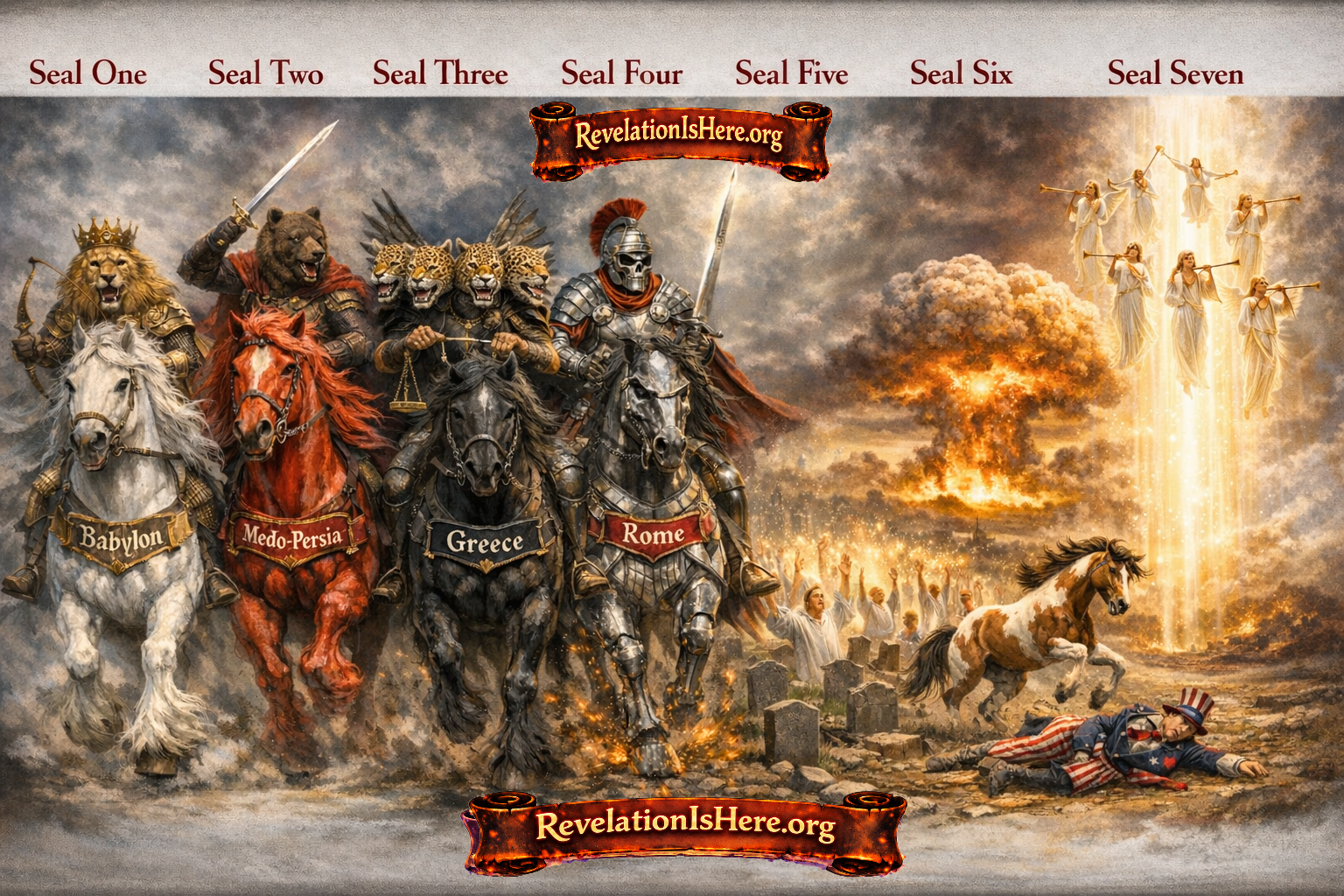
The alignment between Daniel's statue and Revelation's opening of the seals will now be aligned with Daniel's Four Beasts.
The first beast (Daniel seven, verse four), was like a lion with Eagles wings, and the wings were plucked, and it was lifted up to stand upon its feet with a man's heart. This first beast aligns with Babylon, the head of gold and the first seal containing a white horse. The description of standing up with a man's heart would correlate with Nebuchadnezzar's return to sanity after seven years.
The second beast in verse five was a bear, raised up on one side with three ribs in its mouth. This would align with Daniel's statue, the breast and arms of silver, as well as the second seal in Revelation where a red horse is depicted.
The third beast in verse six, is a leopard with four wings and four heads. This would align with Daniel's statue with belly and thighs of brass as well as the third seal in Revelation of a black horse.
In Daniel chapter 7 verse seven another dreadful and terrible beast arises. The fourth beast is extremely strong with iron teeth and it breaks in pieces and stomps the residue with its feet and it is different than all the other beasts. It has ten horns on its head and among these ten horns, a little horn arises. This little horn speaks great words, and eventually becomes a stouter horn, whom before three of the ten horns fall. (Daniel 7, verse twenty). In verse twenty four, the ten horns on the head of the fourth beast will eventually arise. After these ten horns have risen, later another small horn arises from within the midst of them and eventually uproots three of them when it becomes the stouter horn. The ten horns are given into the hand of the stouter horn for time, times, and a half.
This terrible and dreadful beast aligns with Daniel's statue with the iron legs. It also aligns with the fourth seal and its opening, revealing the fourth horse which was pale in color. The Stouter horn in Daniel that eventually arises from the head of the fourth beast aligns with their feet of iron and clay. It also aligns with the sixth seal when it is opened, and there is a display of overwhelming power. It should also be noted that there is an extended amount of time from the Dreadful Beast (the fourth one) until this stouter horn arises to power, just as the length of time with the long legs of iron and the fifth seal where the Saints ask how long and are given white robes.
The ten horns depicted here on this fourth beast should not be confused with the ten horns on the Seven Headed Beast of Revelation. As you will see in the next page, this little horn aligns with the seventh head of Revelation. The ten horns in Revelation are different and arise after the seventh head in that representation.
The most important fact about this Stouter horn, is the giving into his hand for time, times, and a half. This time marker which equals 3.5 years or 1260 days is a crucial identifying factor for the next alignment. This beast and the horn are eventually destroyed. The other three beasts have their Dominion taken away, but their lives are prolonged. After this, God's kingdom is set up and will never be destroyed, for it is everlasting.
SEVEN HEADED BEAST
Aligning the seven heads with Daniel and Revelation.
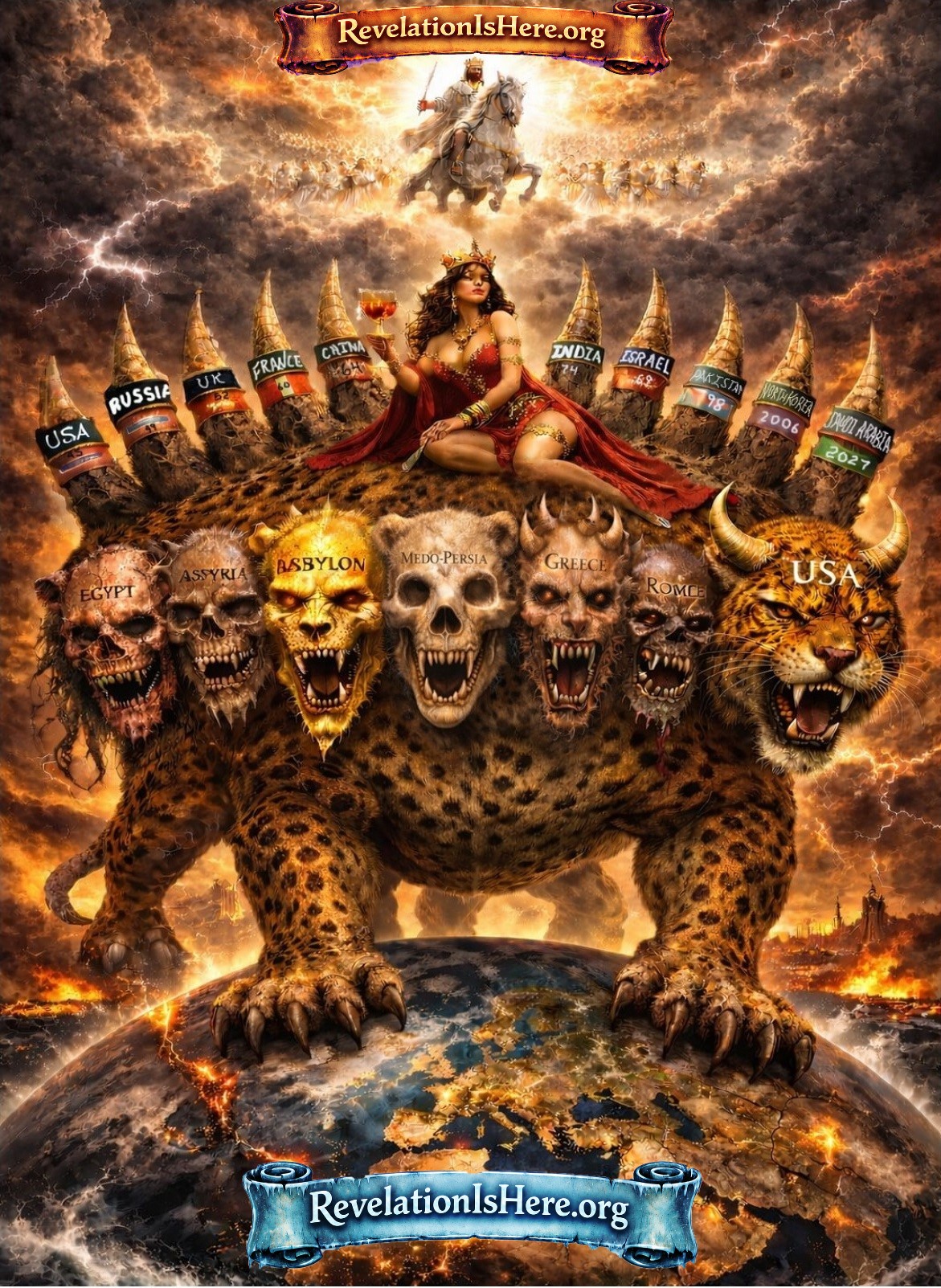
This page is going to align the Four Beasts in Daniel, the Seals in Revelation, and the Statue just studied to the Seven Headed Beast in Revelation chapter thirteen. This is a significant alignment because of the 3.5 years. The Seven Headed Beast has two more powers at the beginning of its existence that do not align with the five discussed powers. Alignment of the five powers does not begin until the third head on the Seven Headed Beast of Revelation.
Before we start this alignment, we need to make sure of our orientation with as much information about this Seven Headed Beast as we can get. In Revelation 17, verse ten, we are told there are seven kingdoms represented by the seven heads. Five are fallen (the first five are no longer dominant). It says the next one "is" and Rome was in power when this vision was given. The last one is not here yet, (the seventh), but when it gets here, it will be for a short time. This helps orientate the alignment but we will need to work backwards. We are going to use two more identifying characteristics in the text to secure the alignment between the last Kingdom of Daniel's Four Beasts (the Stouter Horn) with the last head on the Seven Headed Beast. According to scripture (and the power of deduction) this sixth head on the Seven Headed Beast would be Rome. That means the iron legs of Daniel Statue would be Rome, as well as the Fourth Seal with the pale horse, and the Dreadful Fourth Beast in Daniel's vision. All three of the above illustrations depicted an undetermined amount of time between the last two powers represented. This would dictate a undetermined, long period of time, between the sixth and seventh head on the Seven Headed Beast in Revelation as well.
Starting in Revelation 13, verse one, a beast rises up out of the sea, having seven heads and ten horns and the horns had crowns with blasphemous names on the head of each horn. Verse two says that the beast was like a leopard, with feet like a bear and a mouth like a lion. Those attributes are listed in reverse order of Daniel's first three of the four beasts. This gives a strong correlation between the two showing a sequential order.
In verse three, one of its heads appeared to have come to its end without another head rising to power as the previous heads, which were in close sequential order. It is then stated, in verse three, that after "as it were wounded to death" that it eventually regained another head, because of the wording "and his deadly wound was healed". After another established head was upon this beast, the world was in awe and wondered after the beast. This is illustrated in the wording of verse four "who is like the beast; who is able to make war with it?"
In verse five, (in the King James version), it says that it has "a mouth speaking great things and blasphemies; and power was given unto him to continue for 42 months". In the Green Interlinear Bible, it says "a mouth speaking great things and blasphemies was given to it. And authority to act 42 months was given to it."
This authority to continue 42 months was not given to it by God, because it blasphemes God. In verse six, it says "and he opened his mouth and blasphemed against God, to blaspheme his name, and his tabernacle, and them that dwell in heaven."
This would be an earthly authority for this last head to continue 42 months. This lines up with Daniel's Stouter Horn, which continued 3.5 years, (or time, times, and a half).
We now summarize the alignment of the Seven Headed Beast. The first two powers of the Seven Headed Beast do not align with the other powers. This is because Daniel starts out explaining the statues meaning to Nebuchadnezzar, who was wondering about the future. The past was not in his dream.
The third head on the Beast would be Babylon and aligns with the head of gold, the first Seal with a white horse, and the first beast in Daniel, the lion. The fourth head on the Beast would align with the breast and arms of silver, the second Seal with the red horse, and the second beast of Daniel, the bear. The fifth head on the Beast would align with the belly and thighs of brass, the third Seal with the black horse, and the third beast of Daniel, the leopard.
The sixth head on the Beast has been established as Rome. It aligns with the iron legs, the fourth Seal with a pale horse, and the fourth and Dreadful Beast of Daniel. Next, there's an undetermined long period of time between the sixth head (established as Rome), and the seventh head on the Beast of Revelation. This is illustrated in the wording of the World marveling at the reappearance of a head on the Seven Headed Beast. This is illustrated in Daniel Statue with the long legs up until the feet, the fifth seal when the Saints wonder how long, as well as the time elapsed for the ten horns and the stouter horn to become a significant power on the Dreadful Beast. The last illustration of the undetermined amount of time between Rome and the last kingdom is, the fatal wounding and its healing by the appearance of the seventh head.
The seventh head on the Beast in Revelation aligns with the feet on Daniel's Statue of iron and clay, the opening of the sixth Seal with the unprecedented display of power signifying a new kingdom, the Stouter Horn in Daniel, in which everyone was delivered into his hand for time, times, and a half. The most significant alignment is the 42 months, which is exactly the same time window as Daniel's time, times, and a half. The seventh head that blasphemed God and was given authority to continue 42 months is the same kingdom.
The alignment of the overall structures of worldly powers in Daniel and Revelation is now complete. There are three more visions that need to be aligned with the above overall time frames depicted.
TWO HORNED BEAST
A closer look at the final world power structure.
The first vision we will examine is the Two Horned Beast in Revelation, which is described in the last half of Revelation, chapter thirteen. This one is important because it sets up a new Power structure, which will complete Daniel's statue of the 10 toes. This will also align with the ten horns on the Seven Headed Beast in Revelation chapter 17, verse twelve through eighteen. The third vision examined is the ram and goat in Daniel and will be addressed in the next page, page six.
We start the examination of the Two Horned Beast in Revelation chapter 13, with a realization that important events are sometimes depicted twice or reiterated again because of their significance. We saw this in the trumpets and vials, even though they were separate visions they aligned so closely, that it was obviously another illustration of the same story because of its importance. It has also shown that every one of the kingdoms illustrated, Daniel's statue, the opening of the seals, the Four Beasts in Daniel, and the Seven Headed Beast in Revelation, have all ended with the final Kingdom aligning. The final Kingdom in the illustrations (excluding the ten toes and ten horns) were the feet, the overwhelming power of the seals, the stout horn (for 3.5 years), and the seventh head (for 42 months) on the Seven Headed Beast. In every instance, there was never another singular dominant world power illustrated. Only a ten, multi power structure at the very end. This multi power was after the final singular world power, illustrated in the ten toes at the very end of the statue and the ten horns on the Seven Headed Beast, which have not been addressed yet. Logic dictates then, just as the vials were another illustration of the same topic, so also the Two Horned Beast. This would signify that there is some importance to the understanding of the Two Horned Beast because it is an expansion or a closer look at the seventh head on the Seven Headed Beast. It will be illustrated in the wording, when it describes the characteristics of the Two Horned Beast, the second description of the last singular world power.
The description starts in Revelation chapter 13 verse eleven. The beast comes up out of the Earth. It has the attributes of a lamb, but it has two horns, and it speaks very powerfully as if it were a dragon. The kingdom arising out of the Earth instead of the sea, portrays a new government in a new geographical area. The lamb would signify that it was not aggressive, the two horns representing two seats of power, and it was a powerful kingdom that could back up its words.
Verse 12, it exercises all the power of the first beast before him (the Seven Headed Beast) and caused the whole earth to worship the first beast whose deadly wound was healed. This Two Horned Beast is the one that exercises the power of this Seven Headed Beast. Notice the wording is "worship the beast" not the head. The wording indicates that it is the seventh head, and it exercises all that power, and is the reason for the beast coming back to life and the worshiping of the Beast again.
In verse 13, it says that he does great wonders and makes fire come down from heaven in the sight of mankind. That is what the seventh head did in the sixth seal, displaying the awesome power.
In verse 14, he deceived the Earth because of the power he had (to do these miracles) and convince them that they should make an image to the beast (the whole world) which had the wound and still lives. In verse 15, he had the power to give life unto this image of the beast, and made the whole world worship this image of the beast, less they be killed if not.
At this point (when he brings the image to life), he will no longer be the seventh head on the Seven Headed Beast because he is turning the worship and power over to the image, not himself. Remember, the seventh head or Two Horned Beast, continues only 42 months. He is now setting up this new power structure that will eventually contain the ten kings at the end that will be worshiped. And yes, he will be the first of those 10 kings.
In verse 16, he makes all of his subjects receive an identifying mark, figuratively in their right hand or forehead. This mark or name or number of a name is a requirement to be able to buy or sell. This is not imposed on the whole world, but only the people within this kingdom's structure. Remember, we are trying to identify, this last, singular world power. It is not the only power in the world just the significantly stronger one, stronger than any other at this point. We are just identifying the characteristics of this seventh head.
In verse eighteen, it starts with "Here is wisdom." Revelation thirteen, verse eighteen. This passage requires a closer examination of symbolic usage and narrative structure because of the importance attached to the wording at the beginning of the verse. The phrase "Here is wisdom" appears to function as an attention marker, signaling that careful understanding is required. A similar pattern appears elsewhere in scripture. In Revelation, comparable wording is used immediately before the explanation of the seven heads on the beast. Similar statements also appear in Matthew and Mark during the discussion of the abomination of desolation, where the reader is told, "let the reader understand." In each case, the wording introduces a matter of special significance and calls attention to the importance of careful consideration.
Revelation thirteen, verse eighteen, states that the number being counted is "the number of the beast," and that it is also "the number of a man." The immediate context is still the Two Horned Beast introduced earlier in the chapter. This raises an important structural question concerning the meaning of the two horns.
Throughout Daniel and Revelation, horns consistently represent powers or kingdoms within the structure of a vision. In Revelation seventeen, the ten horns are explicitly identified as kings or kingdoms. In Daniel's visions, the same pattern appears repeatedly. The horns on the dreadful beast represent powers arising within that structure. In Daniel chapter eight, the ram with two horns is identified as Medo Persia, while the goat and its horns also represent ruling powers connected to Greece and the kingdoms that followed.
The consistent symbolic usage suggests that horns generally represent forms of governing authority. However, the context of Revelation thirteen introduces an additional consideration. The framework established throughout the previous alignments (the statue, the seals, the Four Beasts, and the Seven Headed Beast) has consistently progressed toward a final singular dominant power before the appearance of the final multi power structure represented by ten horns or ten toes.
Because this section appears to be a closer examination of that same final singular power, the introduction of an entirely separate kingdom structure at this point would appear inconsistent with the broader progression already established. Within this framework, the two horns may therefore represent dual authority or two seats of power operating within the same overall structure rather than two separate world kingdoms.
Another important factor is the strong correlation previously established between the stouter horn in Daniel and the final head of the beast in Revelation through the shared timeframe of "time, times, and a half" and "42 months." If these parallel structures are correct, then Revelation thirteen continues examining the characteristics of that same power during that same limited period.
With these factors considered together, the wording of verse eighteen may suggest that the relationship between the man, his number, and the two-horned structure provides a means of identifying, six, six, six, the identifying characteristic of the power being described. The passage does not explicitly explain the method, but the wording indicates that wisdom and understanding are required to recognize the relationship being presented.
TEN TOES AND HORNS
We are now going to look into the new power structure that the Two Horned Beast has set up via the image. Remember this Two Horned Beast, is actually just a closer look at the seventh head and he makes the whole world worship the image. This will explain the ten toes on Daniel's image and the ten horns on the Seven Headed Beast of Revelation.
In Revelation 17, verse eight, there is a description of the seven headed beast. It says this beast was, and is not, and shall ascend out of the bottomless pit and go into perdition. In the same verse, it rephrases it as "the beast that was, and is not, and yet is".
These two phrases signify a headless beast until the appearance of the seventh head.
In verse nine the statement "here is the mind which has wisdom" appears again.
In verse 10 it says there are seven kings: five are fallen, one is, and the other is not here yet, and when he comes, it will be for a short space. (42 months).
In verse 11 it reads, the beast that was and is not, even he is the eighth and is of the seven and goes into perdition.
Look carefully at this wording, it is missing the "and yet is" part, it only says "was and is not", signifying that it is no longer. There is a reason for this. It's moving on to the next stage of the seven headed beast and describing what transpires next.
We are looking at this beast in past tense at this point moving on to a new phase where the last head is no longer a power with a singular status because it has moved into a collective. The image has restructured the power framework. Once this new power framework is brought to life the singular status of that seventh head no longer exists. Hence we have the wording the beast itself is of the seven (the whole Earth) and is the eighth.
Verse 12 says, the ten kings have received no kingdom yet but have power as kings one hour with the beast.
Verse 12 and they are of one mind and give their strength and power to the beast, which is now the collective or the new power distribution mechanism ushered into place via this image that the seventh head brought to life.
Inverse 17 God says they will do his will and agree to give their kingdom unto the beast until the words of God should be fulfilled.
In summary, this last head on the Seven Headed Beast will usher in a new power structure, and it will continue just as powerful as before, but it will be the first of the ten kings of this new power structure. This now completes the toes of Daniel's statue and the horns on the Seven Headed Beast frame work.
Our final and last alignment in the next chapter will be to identify this last horn of the 10 found in Daniel chapter 11.
RAM and GOAT
Final vision and the last horn of the ten.
The third vision and final one to be examined is the most difficult for someone to interpret. This is Daniel's vision of the Ram and Goat and how they align with the final and last horn of the ten horns on the Seven Headed Beast.
Once again before laying the structure out; logic, reasoning, and the power of deduction need to establish a few parameters to understand the purpose and significance of this vision.
This long vision of scrimmages between the north and south, migrating into occupation and control, to diplomacy and politics, and then a new God created by the final actor, ends with a significant and concrete time marker for the beginning of tribulation that Jesus referred to in Matthew, Mark and Luke. Jesus reference to this particular vision in Daniel (let the reader understand) can be found in Matthew 24, verse fifteen, Mark 13, verse fourteen. Logic would dictate that this vision is going to progress past our current point in history, since the time of trouble has not yet started. The main character at the end of this vision becomes recognized in past history and continues on up to the time of trouble according to the script. It is possible to identify the king that emerges in this vision, he just hasn't completed the prophecy as of yet. The main take away of this, the vision does not stop in seventy A.D. It continues until the time of trouble.
The second thing that can be deduced, this last King will be the final and tenth horn on the Seven Headed Beast. The previous vision in Daniel of the four beasts and stouter horn identified the stouter horn as the seventh head on the Seven Headed Beast in Revelation. Then the seventh head (lasting 42 months or 3.5 years) transitioned into the first horn on the back of the seven headed beast, because of the new image with its power structure. Since Daniel's previous vision identified the first horn (via Revelation's input) it's only fitting this would be the last of the ten horns. That is why it was so significant in Jesus words about the end. Since the ten horns reign with the beast for an hour just before the time of trouble, we can deduce this is the final and last power to arise just before the seven last plagues. This would also align with Daniel's ten toes and the stone hitting the feet of the image, and the seventh seal.
When Daniel first saw this vision, there was a timeframe of 2300 days mentioned. Generally in prophecy days are represented as years, but here it was made clear, this was to strictly be looked at as days. The initial introduction of this vision was in chapter eight, and it was during the third year of the reign of King Belshazzar. The vision was of a ram with two horns, which are broken off by a goat with one horn. The goat becomes great and there's no power left in the ram and the one horn of the goat is broken off and four come up. Out of one of these four horns, a little horn comes forth and becomes very great. This horn magnifies itself even to the prince of the host and the place of his sanctuary was cast down. There is a new host given against the daily sacrifice because of his transgression, and it cast down truth, practiced, and prospered. This new host is a transgression and a desolation, and cast down the sanctuary and the first host for 2300 days and then the sanctuary will be cleansed. In verse seventeen, Daniel is made to understand this vision was for the time of the end. He was also made to understand that this was 2300 literal days, because in verse twenty six he is told that the evenings and mornings were true, but it will be for many days in the future. Daniel is told in verse nineteen, this would be the last indignation before the time of the end. From verse twenty to verse twenty five we receive the particulars of this vision. The ram was Medo Persia, the goat was Greece, and four kings arising after Greece. At the time of the end, when transgressors are come in to the full, a king of fierce countenance, and understanding dark sentences shall stand up. This is referring to the little horn that arises and becomes great. This little horn is mighty, but not by his own power, and he destroys wonderfully, and is prosperous, practices, and destroys the mighty and holy people. He will magnify himself in his heart, destroy many by peace and stands up against the prince of princes at the end, but will be broken without hand. The important takeaway of this introduction to the vision in chapter eight is; this last kingdom is going to continue 2300 days starting (in chapter 11 verse 31) when he commits the last transgression before the time of trouble, until Christ returns, then the sanctuary will be cleansed. The last transgression again substantiates that this kingdom is the last horn of the ten, or the last toe of the image.
The rest of this vision is continued in chapter ten, in the third year of Cyrus the king, and in chapter eleven (after Daniel fainted), which was the first year of Darius the Mede as well.
But before we get into the lineage of chapter 11, it should be noted that Daniel had a vision recorded in chapter 9 in between the start and finish of the vision being discussed.
It concerned the 70 weeks that were determined upon his people that were held captive in Babylon. There were 69 weeks from the command to rebuild Jerusalem to the death of Jesus. The Messiah would be cut off, but not for himself, and the people of the prince shall come and destroy the city and the sanctuary. The end of this matter would come like a flood, and at the end, the war and desolations are determined. In chapter nine, verse twenty seven, the last week of the 70 weeks is finally mentioned. It says, that he shall confirm a covenant with many for one week; and in the midst of that week he shall cause the sacrifice and oblation to cease, because of the over spreading of abominations. He shall make it desolate even until it is consumed, and that is determined is poured out upon the desolate.
The wording in this scripture and sequential time events put this covenant week just prior to Christ's return. This week is equal to seven days, and as prophecy normally does it would represent a seven year period ending with Christ return. There will be a significant event in the middle of this week, that puts an end to the sacrifices unto the abominations.
This is important and worth noting because of its alignment of, word structure and content with Daniel eight, verse twenty three where it says; at the latter time of their kingdom, when transgressors have come to their full that there would be a king of fierce countenance, understanding dark sentences standing up. Since this is the last indignation before the time of trouble, then the covenant week would be in this same timeframe.
The explanation of this vision can now be completed and it starts in the verse just before chapter 11.
Verse two. There was one king at the time this vision was given, and it was Cyrus, and three more kings stand up. Of these four kings, the fourth shall be richer than all.
From here to verse fifteen, these are battles between the north and the south.
Verse sixteen. The atmosphere changes. The Overcomer is overcome. The loser and the winner of the last battle cannot stand against him, he stands in the glorious land and it will be consumed by him.
From this point on there will be no more battles between the north and south. It becomes a chain of occupying powers, one after the other of the previous king of the south's dominion.
Verse twenty eight, this is where the star and main character of the entire prophecy appears.
Verse twenty nine, from here on these events will have no alignment with history. This is prophecy waiting to be fulfilled.
This is as far as we analyze this chapter. Interpretation is left to the reader. Remember, we are just looking at sentence structure, and meaning with an overall lining of events.
TIMELINES
Aligning the prophetic timeframes.
In this section, we will align some of the time frames by description only.
The 2300 days will begin when this last kingdom sets up its new God, and end with the return of Jesus and the resurrection.
In Daniel chapter twelve verse one through seven there is a timeframe given from the time of trouble until the resurrection and Jesus return of, time, times and a half or 3.5 years.
There is also another timeframe given in verse eleven and twelve, using the Green Interlinear Bible for accuracies sake. It states that, from the time the regular sacrifice shall be taken away, until the abomination that makes desolate set up, is one thousand two hundred ninety days and shall occur. Blessed is he who waits and comes to the one thousand three hundred thirty five days. This gives a total of twenty six hundred twenty five days which equals years. The first temple was destroyed somewhere around 600 BC. The statement blessed is he is because that would be the start of the confirmation week.
SUMMARY:
This construction of a framework, explanation of sentence structure, and meanings will hopefully help with the understanding and interpreting of these two very important books. AI can assist in the interpretation of Daniel's chapter 11, but it is a long, tedious process. For a separate interpretive study that builds on this framework, see RevelationIsHear.com
The grace of our Lord Jesus Christ be with you all. Amen.